
.png)
If you work on a construction site, you have heard the term BBS. It tells the team exactly how many steel bars to cut, how long each one should be, and how much steel to order. A mistake here means wasted steel, wasted money, and delays.
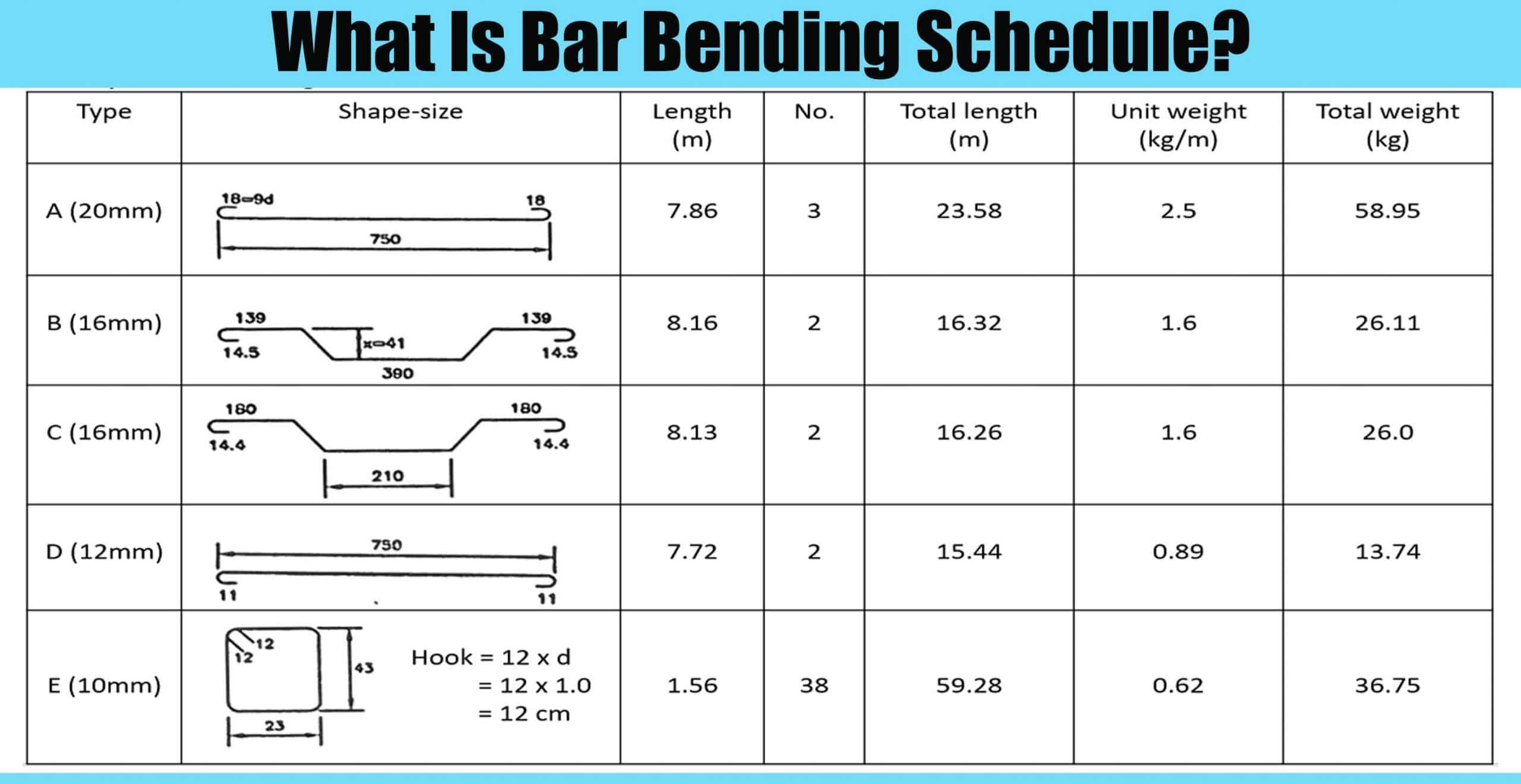
A Bar Bending Schedule is a table that lists every steel bar in a structure. For each bar, it gives the bar mark, shape, diameter, number of bars, cutting length, and total weight.
Think of it as a shopping and cutting list for steel.
Number of stirrups = (Length ÷ Spacing) + 1, always rounded up
Cutting length = Length before deduction − (Number of bends × Deduction × Bar diameter)
| Bend angle | Deduction |
|---|---|
| 45° | 1 × diameter |
| 90° | 2 × diameter |
| 135° | 3 × diameter |
Why deduct? When a bar is bent, its length measured along the outside corner is longer than the length actually needed. The deduction fixes that.
Length = 2(A + B) + 24 × diameter (for 135° hooks)
Here, A = beam width − 2 × cover, and B = beam depth − 2 × cover.
Unit weight (kg/m) = D² ÷ 162, where D is in mm
Weight = Total length (m) × Unit weight
Here is the beam used in the sample sheet:
Reinforcement used:
| Bar | Dia | Nos per beam |
|---|---|---|
| Bottom main bars | 16 mm | 3 |
| Top bars | 12 mm | 2 |
| Extra top bars at supports | 12 mm | 4 |
| Stirrups | 8 mm | calculated |
5,500 ÷ 150 = 36.67, and 36.67 + 1 = 37.67, which rounds up to 38 stirrups per beam.
A = 300 − 50 = 250 mm and B = 450 − 50 = 400 mm
Length = 2 × (250 + 400) + 24 × 8 = 1,492 mm
Length before deduction = 5,500 − 50 + (2 × 12 × 16) = 5,834 mm
Two 90° bends: deduction = 2 × 2 × 16 = 64 mm
Cutting length = 5,834 − 64 = 5,770 mm
16 mm bar: 16² ÷ 162 = 1.58 kg/m
Total length = 5.77 m × 12 bars = 69.24 m
Weight = 69.24 × 1.58 ≈ 109.4 kg
The sheet does this for you. For these 4 beams, the total comes to about 261 kg of steel. Adding 3% wastage, you should order about 269 kg.
=ROUNDUP(Length/Spacing+1,0).D² ÷ 162 kg per metre, where D is the diameter in mm.
Because stirrups are placed at both ends of the length. Count the gaps, then add one more stirrup.
Yes, for most site and estimation work. Specialised detailing software helps on very large projects, but Excel is quick, cheap, and easy to check.
Many sites use about 3–5%. Follow your company or project rules.
A good BBS saves steel, time, and arguments on site. Start with the sample sheet, change the yellow cells to match your drawing, and check the totals. Once you’re comfortable, build the same type of sheet for columns, slabs, and footings.
.png)
SONA at ACE TECH Bengaluru 2026: Construction Equipment Showcase Recap
Bar Bending Schedule (BBS) Using Excel in 2026
.jpg)
Grades of Concrete (M5 to M80): Uses, Strength and How to Compact Each Grade Properly
Automatic Stirrup Bending Machine: Complete Price & Buying Guide (India)

Rebar Bending Machine Price in India: Types, Capacity, Power & Complete Buying Guide

Copyright © 2026 Sona Construction Technologies Private Limited