
The construction industry is evolving rapidly. Projects are becoming larger, deadlines are becoming tighter, and labour costs continue to rise every year. In this environment, contractors and rebar processing businesses can no longer afford inefficient production methods. Every minute saved in steel processing directly impacts project timelines, profitability, and competitiveness.
One of the most critical components in reinforced concrete construction is the stirrup. Whether it is a residential building, commercial tower, industrial structure, bridge, metro corridor, flyover, or highway project, thousands of stirrups are required to reinforce beams, columns, footings, and other structural elements.
For decades, contractors relied on manual or semi-automatic methods to manufacture stirrups. However, modern automation has introduced high-speed machines capable of producing thousands of precision stirrups with minimal labour involvement.
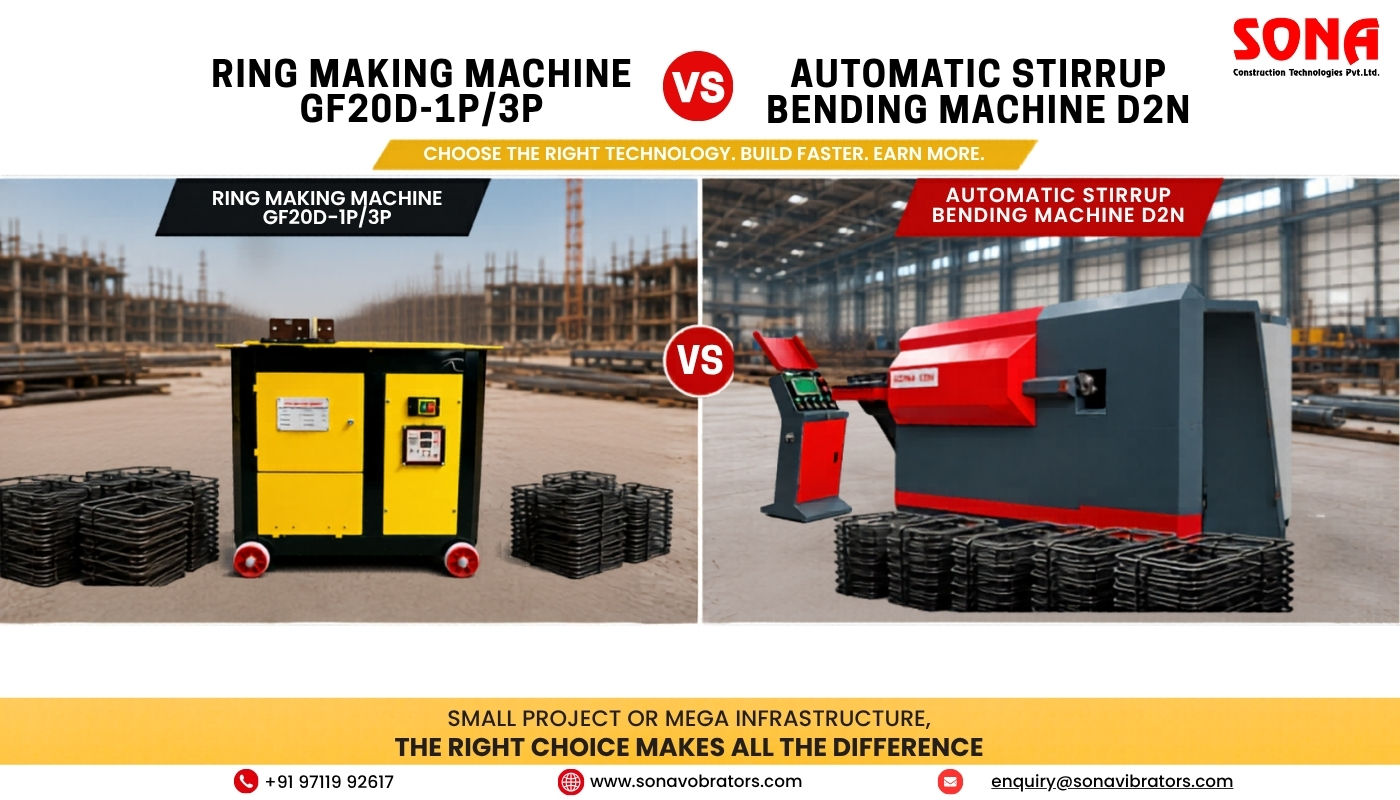
Today, two popular solutions dominate the market:
While both machines are designed to manufacture stirrups, they differ significantly in terms of technology, productivity, labour dependency, accuracy, operational costs, and long-term profitability.
This comprehensive guide will help contractors, builders, rebar fabrication units, and infrastructure companies understand the strengths and limitations of both machines and determine which solution is best suited for their operations.
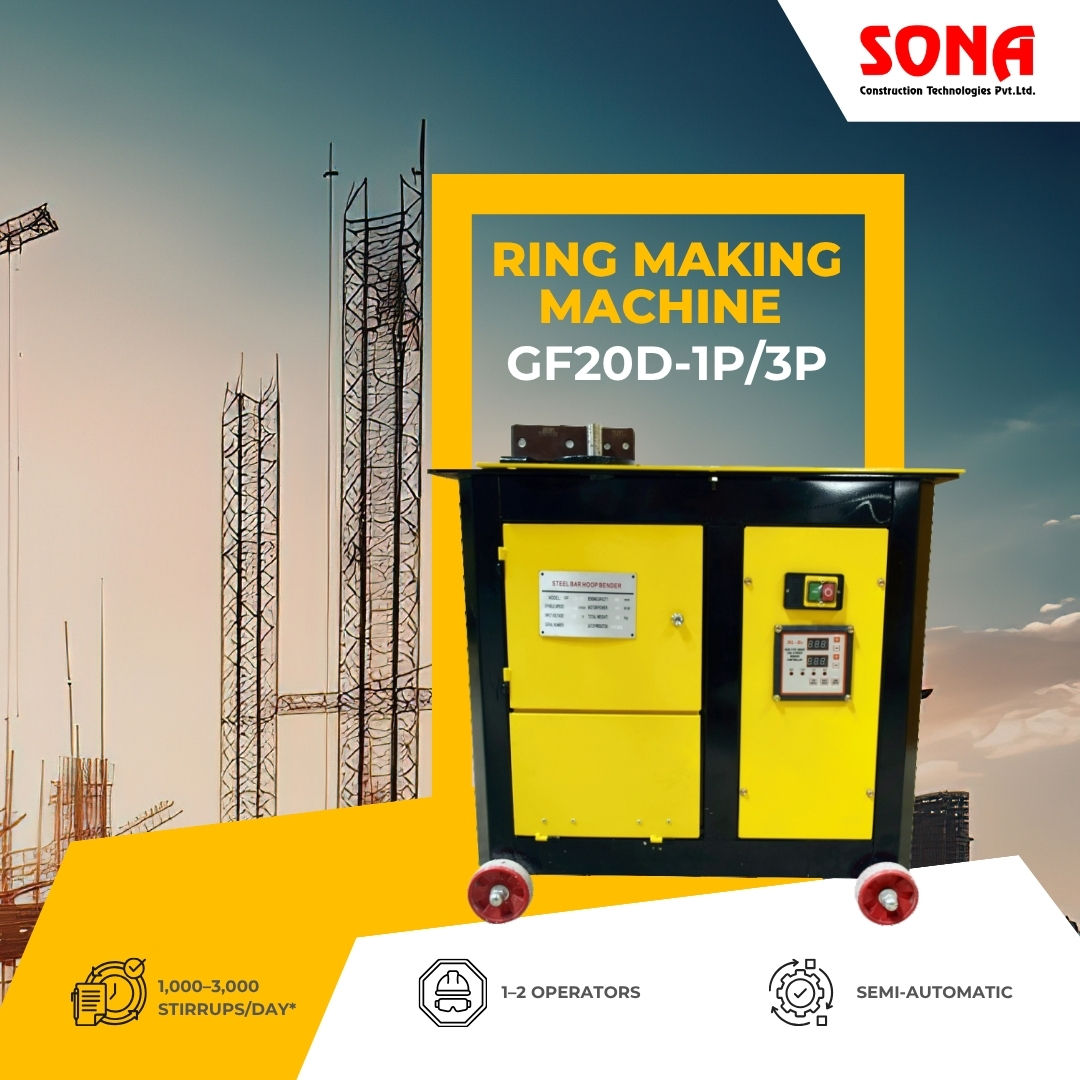
The GF20D-1P/3P Ring Making Machine is a semi-automatic rebar processing machine designed for manufacturing square, rectangular, and other closed-loop stirrups used in reinforced concrete construction. The machine has gained popularity among small and medium-sized contractors due to its relatively low investment cost, ease of operation, and compact design.
Unlike fully automated systems, the GF20D-1P/3P requires operators to manually feed the steel bar and assist in various stages of the production process. The machine then performs the bending operation to create the desired stirrup shape. This approach offers a balance between affordability and productivity, making it suitable for businesses that require moderate production volumes without investing in advanced automation.
For contractors handling residential buildings, small commercial projects, and local construction activities, the machine often provides sufficient production capacity while maintaining manageable operating costs.
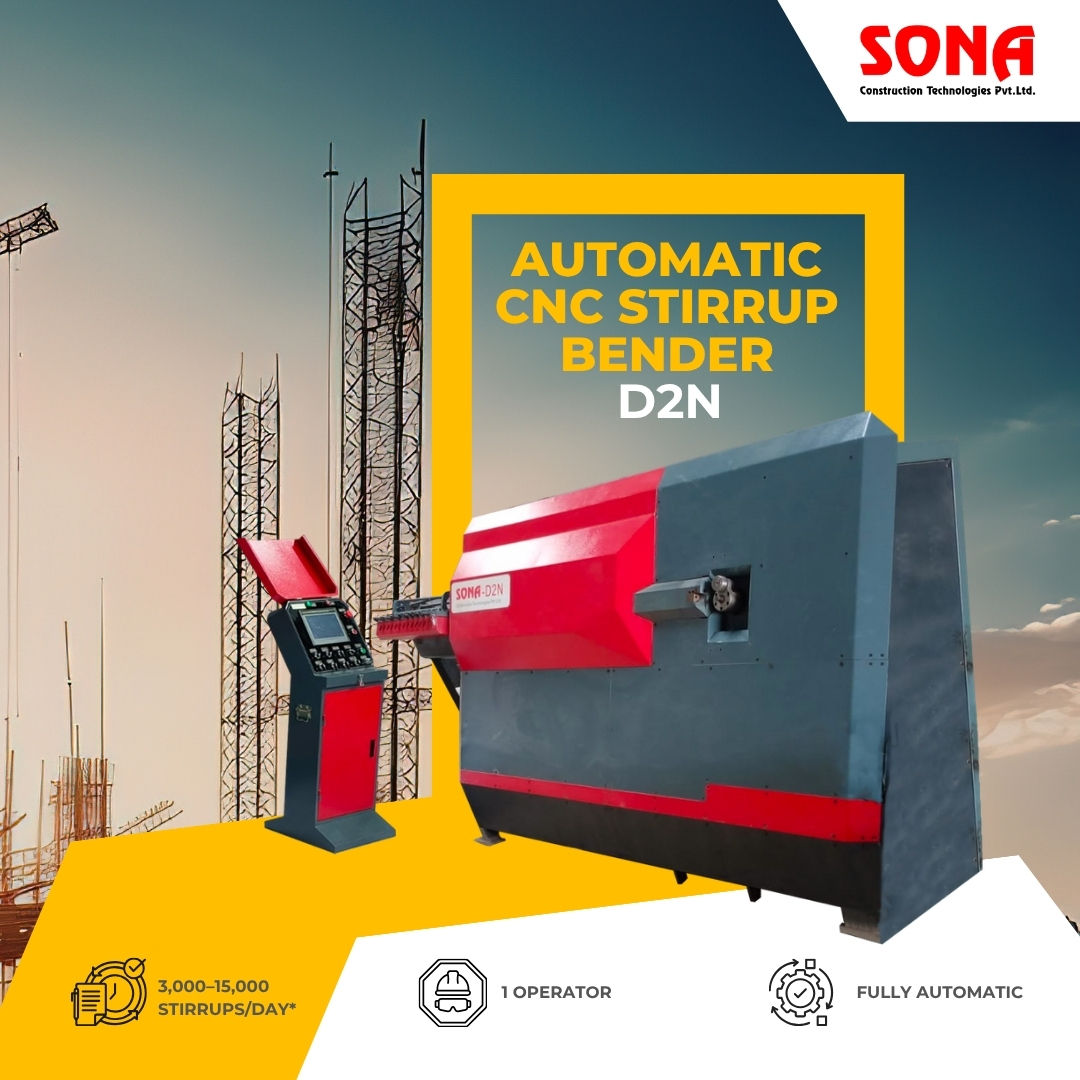
The D2N Automatic Stirrup Bending Machine represents a completely different level of rebar processing technology. Unlike conventional ring making machines, the D2N is a fully automatic CNC-controlled system capable of performing multiple operations in a continuous production cycle.
The machine automatically :
All of these processes occur automatically with minimal operator intervention.
As a result, the D2N dramatically increases production speed, reduces labour dependency, improves dimensional accuracy, and minimizes material wastage. For large contractors and rebar processing centres, automation enables the production of thousands of stirrups daily without the limitations associated with manual handling.
| Specification | Ring Making Machine GF20D-1P/3P | Automatic Stirrup Bending Machine D2N |
|---|---|---|
| Machine Type | Semi-Automatic Ring Making Machine | Fully Automatic CNC Stirrup Bending Machine |
| Automation Level | Semi-Automatic | Fully Automatic |
| Feeding System | Manual Feeding | Automatic Coil Feeding |
| Straightening Function | Not Available | Integrated Automatic Straightening |
| Cutting Function | Separate Operation Required | Automatic Cutting |
| Bending Function | Automatic Bending after Feeding | Automatic Bending with CNC Control |
| Processing Material | TMT Bars | Coil Wire / Rebar Coil |
| Bar Diameter Range | 4-12 mm (depending on model) | 5-12 mm Single Wire / 5-10 mm Double Wire |
| Stirrup Shape | Square, Rectangle, Custom Rings | Square, Rectangle, Polygon, Custom Shapes |
| Production Capacity | 1,000-3,000 Stirrups/Day | 3,000-15,000 Stirrups/Day |
| Operating Speed | Operator Dependent | High-Speed Continuous Production |
| Operator Requirement | 1-2 Operators | 1 Operator |
| Labour Dependency | High | Very Low |
| Accuracy | Good | High Precision CNC Accuracy |
| Dimension Consistency | Moderate | Excellent |
| Programming Capability | Manual Settings | Digital PLC/CNC Programming |
| Shape Memory Storage | Not Available | Available |
| Material Wastage | Moderate | Minimal |
| Production Repeatability | Operator Dependent | Consistent Output |
| Maintenance Complexity | Low | Medium |
| Power Consumption | Lower | Moderate |
| Skill Requirement | Moderate | Basic Programming Knowledge |
| Suitable Project Size | Small to Medium Projects | Medium to Large Projects |
| ROI for High Volume Production | Moderate | Very High |
The most significant difference between these machines lies in their operating philosophy.
The Ring Making Machine relies on a combination of human labour and mechanical assistance. While it improves productivity compared to manual bending methods, it remains dependent on operator skill and consistency.
The D2N, on the other hand, relies on CNC programming and automated controls. Once the operator enters the required dimensions, the machine continuously produces stirrups with remarkable precision and repeatability.
This distinction affects nearly every aspect of performance, including production speed, labour requirements, quality control, and operating costs.
For businesses planning long-term growth, understanding this technological difference is essential before making an investment decision.
Production capacity is often the primary factor influencing machine selection.
The GF20D-1P/3P typically produces between 1,000 and 3,000 stirrups per day, depending on:
For small projects, this output may be perfectly adequate.
However, as project sizes increase, production limitations become increasingly apparent.
The D2N Automatic Stirrup Bending Machine operates at a significantly higher level, producing approximately 3,000 to 15,000 stirrups per day depending on configuration and operating conditions.
This substantial increase in productivity can transform the economics of a rebar processing operation.
A contractor who previously required multiple machines and several workers may be able to achieve the same output using a single automated system with one operator.
For infrastructure projects where deadlines are strict and production volumes are massive, this productivity advantage becomes a major competitive benefit.
Labour shortages and rising wages have become major challenges across the construction industry.
The GF20D-1P/3P generally requires one or two operators to manage material feeding, bending operations, and finished product handling.
While this labour requirement may seem manageable, costs accumulate over time. Additionally, productivity often fluctuates based on operator experience, fatigue, and attendance.
The D2N significantly reduces labour dependency. A single operator can typically oversee the entire production process.
Since the machine handles feeding, measuring, cutting, and bending automatically, human involvement is limited to setup, monitoring, and material loading.
Over several years of operation, labour savings alone can justify a substantial portion of the machine's investment cost.
Steel is one of the largest cost components in reinforced concrete construction. Even small reductions in material wastage can generate significant savings over the course of a project.
Semi-automatic systems frequently experience wastage caused by:
These losses may appear minor on a daily basis but become substantial when processing large volumes of steel.
The D2N uses automated measurement and cutting systems that optimise material utilisation.
Precise length control reduces scrap generation and minimises costly errors.
For businesses processing several tonnes of reinforcement steel daily, improved material efficiency can translate into significant annual savings.
The GF20D-1P/3P benefits from a relatively simple design.
Its maintenance requirements are generally straightforward and include:
The simplicity of the system often results in lower maintenance costs and easier troubleshooting.
The D2N incorporates advanced components such as:
While these systems require more structured maintenance programmes, they also deliver significantly higher productivity.
For businesses operating at large scale, the additional maintenance complexity is usually outweighed by the performance benefits.
Many buyers focus exclusively on the initial purchase price when comparing machines.
This approach can be misleading.
The GF20D-1P/3P offers a lower initial investment and may provide excellent value for contractors with modest production requirements.
However, its long-term operating costs include:
The D2N typically requires a larger initial investment, but generates returns through:
For businesses processing large volumes of reinforcement steel, automation often delivers substantially greater profitability over the machine's lifespan.
The answer depends entirely on your production requirements and business objectives.
If you are a small contractor, local fabrication workshop, or builder handling limited volumes of reinforcement steel, the GF20D-1P/3P can provide a practical and economical solution.
Its affordability, simplicity, and ease of operation make it an attractive choice for smaller operations.
However, if you are a rebar processing centre, infrastructure contractor, precast manufacturer, or large construction company, the D2N offers clear advantages.
Its ability to produce thousands of precision stirrups with minimal labour involvement enables higher productivity, lower operating costs, and greater scalability.
As project sizes continue to grow and labour challenges intensify, automated rebar processing technology is increasingly becoming the industry standard.
The comparison between the Ring Making Machine GF20D-1P/3P and the Automatic Stirrup Bending Machine D2N is ultimately a comparison between traditional semi-automatic production and modern automated manufacturing.
The GF20D-1P/3P remains an excellent option for contractors seeking affordability and simplicity. It provides reliable stirrup production for small and medium-sized projects while maintaining manageable investment costs.
The D2N, however, represents the future of rebar processing. Its superior productivity, precision, labour efficiency, and material utilisation make it the preferred choice for businesses aiming to increase profitability and compete in large-scale construction markets.
For companies planning long-term growth, the decision is becoming increasingly clear: automation is no longer a luxury, it is a competitive necessity.
.jpg?updatedAt=1792230595960)
₹12.2 Lakh Crore for Infrastructure: Which Construction Machines Will Be in Demand?
.png)
SONA at ACE TECH Bengaluru 2026: Construction Equipment Showcase Recap
.png)
Bar Bending Schedule (BBS) Using Excel in 2026
.jpg)
Grades of Concrete (M5 to M80): Uses, Strength and How to Compact Each Grade Properly
Automatic Stirrup Bending Machine: Complete Price & Buying Guide (India)

Copyright © 2026 Sona Construction Technologies Private Limited